
For Quick Serve Restaurants (QSR) and foodservice brands, the moment of truth no longer happens exclusively at the counter. In an era of third-party delivery platforms and off-premise dining, the customer experience often begins when the food arrives at the door.
That means packaging plays a critical role in maintaining product quality, presentation, and brand perception. If packaging fails during transport, the meal may arrive compromised, regardless of how well it was prepared in the kitchen.
For brands operating in delivery, takeout, and drive-through environments, packaging performance testing has become an essential part of protecting the customer experience.
The Technical Challenge: Packaging Performance Beyond the Kitchen
Off-premise dining introduces environmental stressors that traditional foodservice packaging was not always designed to handle.
Heat, humidity, transport vibration, stacking pressure, and time delays can all affect how packaging performs during delivery. Testing these variables in controlled laboratory environments allows brands to identify potential failure points and improve packaging design before issues appear in the field.
Our customized testing methods, combined with internationally recognized standards, simulate the real-world challenges packaging experiences between the restaurant and the customer.
Some of the most common performance challenges include:
Heat Retention vs. Proper Venting
Maintaining food temperature is important, but excessive heat retention can trap moisture inside the container. Without proper venting, condensation builds up and can lead to soggy textures that negatively impact food quality.
Leak Resistance During Transport
Delivery drivers encounter turns, stops, and constant movement during transport. Packaging must maintain seal strength and structural integrity to prevent leaks that damage both the product and the customer experience.
Stacking Strength
Inside a delivery bag, multiple containers are often stacked together. Packaging must be able to withstand vertical pressure without collapsing, crushing food, or losing structural stability.
Ink Performance Under Heat and Moisture
Packaging graphics are part of the brand experience. Testing ensures that inks do not bleed, smear, or transfer onto food or customers’ hands due to heat or condensation.
Print Quality and Visual Presentation
High-resolution printing helps reinforce brand quality. If packaging graphics degrade or appear distorted upon arrival, it can affect how customers perceive the product and the brand.
By evaluating these performance factors early, brands can prevent costly packaging failures after products reach the market.
Success in Action: Reducing Packaging Defect Rates by 65%
The value of packaging performance testing becomes even clearer when applied over time.
In one recent example, a large QSR brand experienced a significant increase in consumer complaints related to their take-home packaging bags. Customers reported tearing, structural failures, and inconsistent performance during transport.
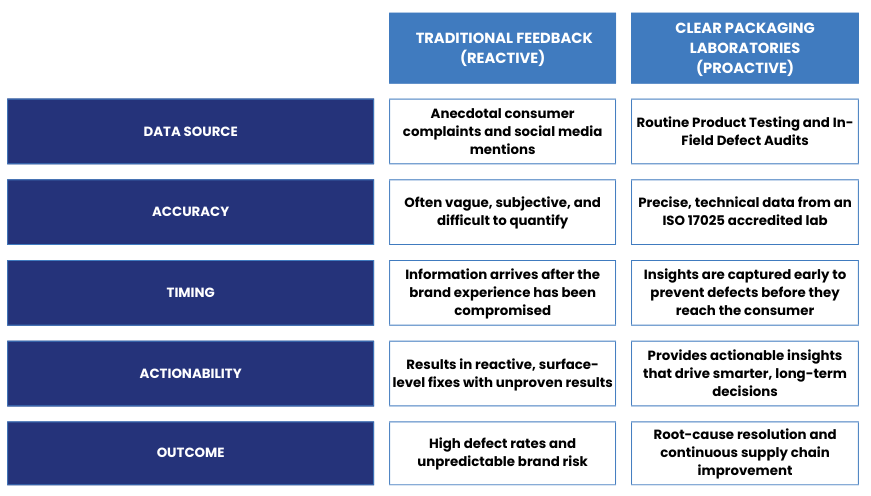
To better understand the issue, Clear Packaging Laboratories implemented a routine product testing program combined with an in-field defect audit program. This approach allowed the brand to move beyond anecdotal complaints and begin measuring packaging performance using structured data.
By identifying the root causes of failures and implementing targeted improvements, the brand was able to significantly improve packaging consistency.
Over a 24-month period, field defect rates dropped from more than 14% to under 5%, representing a reduction of more than 65% in packaging failures.
The result was improved customer satisfaction, reduced complaint volume, and better long-term packaging reliability.
Where Data Meets Packaging
Packaging performance is no longer just a design consideration, it is a measurable component of brand quality in delivery and takeout environments.
As an ISO/IEC 17025 accredited laboratory, Clear Packaging Laboratories provides independent testing that helps brands evaluate packaging durability, structural integrity, and performance under real-world delivery conditions.
In addition to testing, our team works with clients to interpret performance data and identify practical improvements across packaging design, materials, and supply chains.
For QSR and foodservice brands operating in a delivery-first world, proactive packaging testing helps prevent failures before they reach the customer.
The Future of Foodservice Packaging
As delivery and off-premise dining continue to grow, packaging performance will play an increasingly important role in protecting product quality and brand reputation.
By combining laboratory testing, field data, and performance analysis, foodservice brands can design packaging systems that perform reliably throughout the entire delivery journey—from the kitchen to the customer’s table.